You're Using Subsidized AI (Copy)
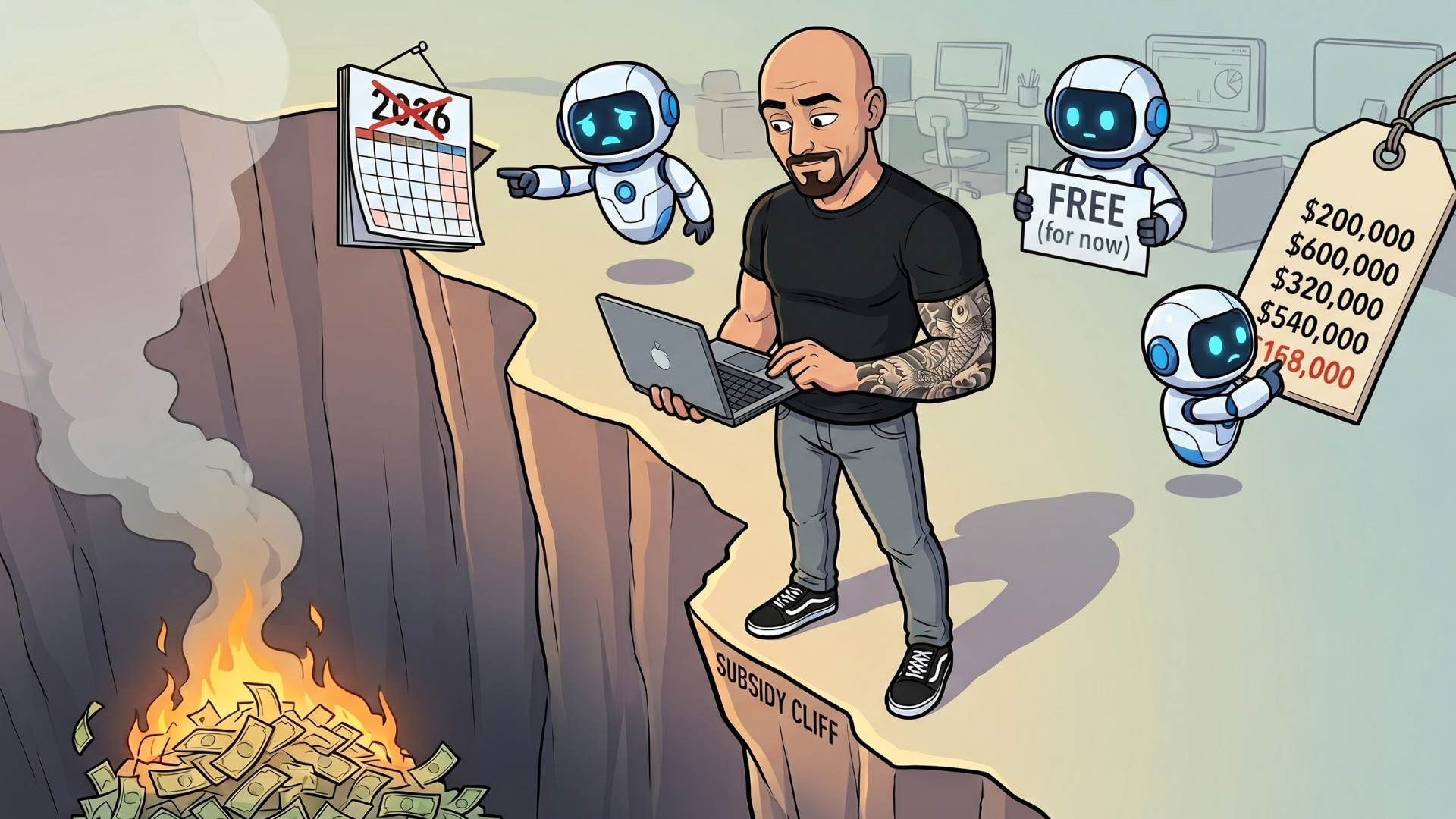
Right now, every time you ask ChatGPT a question or run a Claude prompt, someone is losing money on you.
Not breaking even. Losing money.
OpenAI burns through $1.4 million daily just to keep systems running. Anthropic's gross margins were negative 94% in 2024. Your $20 monthly subscription does not come close to covering what it costs to answer your questions. The companies offering these tools are absorbing the difference, and they are doing it on purpose.
This is not a bug. It is the strategy.
Tech companies are absorbing massive operational costs to provide free or heavily discounted access to advanced language models, designed to capture market share early and embed new tools into daily routines. The goal is simple - get you hooked before you realize how much you need it. Then, when the bill comes due, you will pay because walking away will feel impossible.
We have seen this playbook before. Cloud providers did the same thing. They subsidized infrastructure for years, let companies build their entire tech stack on AWS or Azure, then raised prices once switching became too expensive to consider. The AI industry is running the exact same play, just bigger and faster.
What We Are Is Seeing
We work with mid-market companies that are neck-deep in AI pilots right now. Most of them have no idea what they are actually spending.
One client came to us last month excited about their AI adoption numbers. Usage was up 300% quarter over quarter. Great news, right?
Then we looked at the invoices. Their AI consumption costs had gone from $8,000 a month to $47,000. Nobody had been tracking it because the procurement team thought it was still covered under the original pilot budget. The finance team did not even know the line item existed.
When we asked if they had measured ROI, we got blank stares.
Most companies do not have great systems in place to measure return on their AI investments. They are spending money they cannot see on outcomes they cannot prove, subsidized by vendors who are counting on exactly that confusion.
The Timeline Nobody Is Talking About
The free lunch ends in 2026.
Analysts predict this era of free and heavily subsidized access will end by 2026, as the industry shifts its focus toward strict paywalls, enterprise contracts, and long-term profitability. The 2026 timeline aligns with the expected completion of many next-generation data centers. Once the infrastructure is in place and operational costs stabilize, the focus shifts from building the foundation to extracting value from the users running queries on it.
Here is what that transition looks like:
1. Late 2026 - Free tiers get slower and more limited. High-context models move behind paywalls.
2. 2027-2028 - Frontier models become subscription or usage-based services, negotiated like cloud contracts.
3. 2030 and beyond - AI functions as a metered utility, priced like broadband or electricity.
OpenAI alone signed $1.4 trillion in computing deals spanning eight years, including $250 billion to Microsoft, $38 billion to AWS, and $300 billion to Oracle's Stargate project. That money has to come from somewhere. It is going to come from you.
Four Things To Do Before The Cliff
You cannot stop the subsidy from ending, but you can make sure it does not wreck you when it does.
1. Track your actual consumption costs. Not what your subscription says. What your team is actually using. Most AI platforms bury usage metrics three menus deep. Dig them out. Create a monthly report. If you do not know what you are spending now, you have no prayer of budgeting for what comes next.
2. Document your ROI right now. Pick three workflows where AI is delivering measurable value. Time saved, error reduction, revenue impact - whatever you can quantify. Get those numbers on record while the tools are still cheap. When the CFO asks if you can justify a 5x price increase, you will need proof.
3. Build multi-model fluency. Do not marry one vendor. Learn to move workloads between OpenAI, Anthropic, Google, and open-source models. Not every task requires the most advanced frontier model - small, efficient models can handle routine drafting and summarization, while more capable systems can be reserved for complex or high-stakes decisions. That flexibility is your leverage.
4. Plan for the cliff in your contracts. If you are signing a multi-year enterprise agreement right now, demand price protection clauses. Cap annual increases. Lock in usage tiers. The vendors want you locked in. Make them earn it by giving you predictability in return.
The Real Subsidy
The four largest technology companies in the world - Amazon, Google, Meta, and Microsoft - are collectively pouring nearly $700 billion into AI infrastructure in 2026. That is more than the GDP of all but the top 20 national economies.
That money is not charity. It is customer acquisition at industrial scale.
The strategy relies on the assumption that by 2026, users will consider artificial intelligence an indispensable tool for both personal and professional tasks. The bet is that you will build your workflows, train your team, and restructure your operations around AI tools before you realize what they actually cost. Then, when the prices go up, you will pay because the alternative is starting over.
They are probably right.
Want help applying this to your product or strategy? We’re ready when you are → Let's get started.